
Need containers delivered to your job site fast? Call Capitol Storage at 617-387-2070.
The terms get used interchangeably, sometimes by vendors, sometimes in your own procurement paperwork, but shipping containers Massachusetts businesses rely on for long-haul transport are not the same animal as a storage container rental Massachusetts operators lease for on-site use. Getting that distinction wrong at the quote stage can cost you lead time, money, and storage configuration headaches you don’t need on a live project.
This breakdown is written for operations managers, general contractors, procurement leads, and facility teams who need the right container spec, not a general overview.
What Makes a Shipping Container Different from a Storage Container?
A shipping container is built to ISO standards for intermodal transport. It’s rated to stack, tolerate ocean salt exposure, and lock into twist locks on vessel decks and flatbed chassis. The structural engineering behind a true ISO shipping container prioritizes stackability under load, not door access or ground-level usability.
A storage container rental, by contrast, is configured for stationary, ground-level use. The steel shell is the same corten construction, but the operational priorities are different: walk-in access, security hardware, interior headroom, and delivery to a surface that isn’t a port terminal. When a contractor in Worcester or a distribution operation in Lowell calls for a storage container rental Massachusetts, they’re looking for a unit that works as a lockable on-site structure, not a freight asset.
The confusion comes from the fact that many storage containers started life as ISO shipping containers. After they age out of the shipping rotation, they get repurposed for ground-level storage. So the hardware is similar, but the use case has changed entirely.
When Your Operation Needs a Storage Container Rental
Most operations asking about shipping containers Massachusetts businesses use actually need a storage container rental. Here’s how that breaks down by use case:
Construction site storage is the most common scenario. A GC staging a mid-size commercial build in Brockton or a municipal infrastructure project in Haverhill needs secure, weatherproof tool and material storage on site. A 20-ft or 40-ft rental unit placed at grade handles this without any crane or chassis requirement.
Manufacturing overflow is another clear application. Plants running at capacity need somewhere to park finished goods, raw material surplus, or tooling between production runs. A storage container rental in Massachusetts placed in a yard or loading dock area extends that capacity without a lease amendment or capital expenditure.
Municipal and institutional operations (DPW yards, school districts, hospitals managing capital improvement projects), routinely use container rentals for seasonal equipment, records staging, or construction-phase storage. Rental terms flex month to month, which matches the project-driven nature of that work.
Logistics and 3PL overflow storage is the fourth common scenario, particularly for regional distribution operations in the I-495 corridor and around the 128 belt. A rental container at the yard handles short-term volume spikes without renegotiating warehouse square footage.
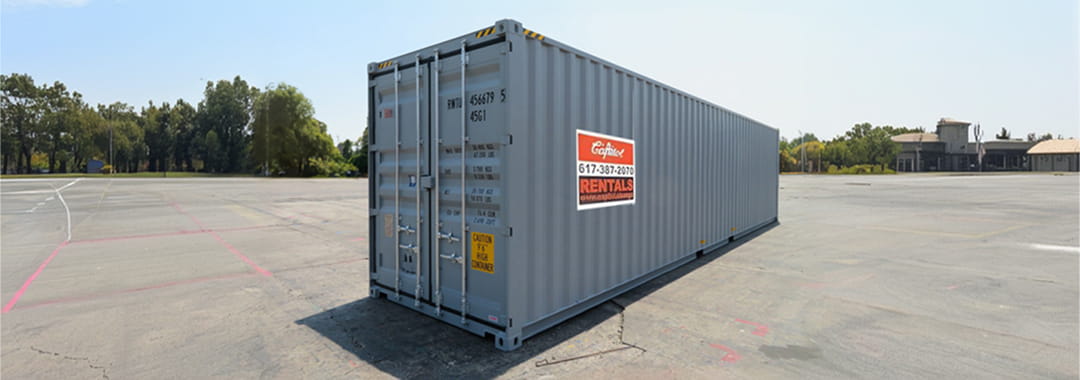
20-ft and 40-ft containers available in Standard, High Cube, and Double Door & are ready for delivery statewide. Get your free quote today.
Container Specs That Matter for Business Use
When evaluating a storage container rental Massachusetts for commercial or industrial applications, three configuration decisions drive the spec:
Size: 20-ft vs. 40-ft.
A 20-ft unit gives you roughly 1,165 cubic feet of interior space, workable for tool storage, equipment staging, or overflow material on a mid-size job site. A 40-ft unit nearly doubles that to around 2,390 cubic feet, making it the right call for larger-volume manufacturing storage, fleet equipment, or multi-trade staging areas.
High Cube Configuration
Standard containers run 8’6″ exterior height. The high cube variation adds a full foot, bringing interior clearance to just under 9 feet. For operations storing palletized goods, racking systems, or tall equipment, high-cube is often the smarter spec, giving you more usable volume without a longer footprint.
Double Door Access
Standard containers have doors on one end. Double Door units open at both ends, which matters significantly for operations where drive-through loading, FIFO inventory management, or through-access workflow is a priority. Industrial operations handling bulk materials or high-frequency stock rotation typically find Double Door worth the spec upgrade.
When You Actually Do Need a Shipping Container
There are legitimate scenarios where the ISO shipping container spec (not a storage rental) is the right answer. If your business is moving freight via ocean or rail intermodal, exporting goods, or working in port logistics, you’re operating within a system that requires ISO certification. In those cases, you’re procuring through a freight or leasing company with the intermodal certification chain, not a regional rental provider.
There’s also a hybrid scenario worth flagging: businesses purchasing containers outright for permanent on-site infrastructure — cold storage conversions, custom workshops, modular office builds, or equipment bays — sometimes start with ISO shipping container specs because they’re widely available as used units. In Massachusetts, Capitol Storage handles both outright sales and rent-to-own programs for operations that want a permanent container asset rather than a recurring rental.
But for the majority of businesses searching for shipping containers Massachusetts as a way to solve a near-term on-site storage problem, the storage container rental is the right product. It’s faster, more flexible, and purpose-built for ground-level business use.
What to Look for in a Storage Container Rental Provider
Not every container rental company in Massachusetts operates at commercial and industrial scale. A few things to verify before you commit:
Fleet inventory matters. A provider that only carries a handful of units can’t reliably handle multi-unit orders, same-week delivery, or scale-up during peak project phases. For storage container rental Massachusetts at commercial volume, you need a company with real inventory depth and direct delivery capability, not a broker.
Delivery capability is non-negotiable. Containers need to be placed precisely on grade, within your yard footprint, positioned for your access workflow. Ask whether the company runs its own delivery equipment or subcontracts. A company running its own fleet controls scheduling, placement accuracy, and response time when plans change mid-project.
Flexible rental terms are standard for project-driven work. Month-to-month agreements are appropriate for construction and renovation timelines where the end date isn’t locked. Avoid providers that push long minimums on straightforward rentals.
Membership and certifications indicate operational credibility. Capitol Storage is NPSA-member, veteran-owned, and holds active Chamber memberships in its service markets across Massachusetts, New Hampshire, and Rhode Island.
Same-day quotes, 24-hour delivery available: Capitol Storage serves contractors and businesses across Massachusetts. Call 617-387-2070 now.
Get the Right Container for Your Massachusetts Operation
If your operation runs on tight project timelines and you can’t afford the wrong spec, the right conversation starts with a vendor who knows the difference between a freight asset and a ground-level storage solution and stocks the inventory to match. Capitol Storage serves contractors, manufacturers, municipalities, and logistics operations across Massachusetts with 20-ft and 40-ft rentals, rent-to-own programs, and direct delivery. Whether you need a single unit on a job site or a multi-container staging setup for a large-scale build, the team is ready to quote same day. Call 617-387-2070 and get your containers placed before the project clock moves.